How Many Protein Shakes a Day Is Safe? (Is 2 or 3 Too Much?)
For many healthy adults, one or two protein shakes a day can fit comfortably into a balanced diet. Three may also be appropriate for some athletes or people with unusually high protein needs, but there is no universally safe number that applies to everyone.
That is because a shake is not a standard unit of measurement. A ready-to-drink bottle containing 16 grams of protein and a homemade shake made with whey, whole milk, oats and peanut butter are both “one shake,” but their protein and calorie content can be completely different.
What matters most is your total daily protein intake, the calories in each shake, your health, and what those shakes are replacing.
Here is how to calculate the number that makes sense for you.
The Short Answer: How Many Protein Shakes Should You Drink a Day?
These practical ranges work as a starting point not a medical prescription

- Sedentary or lightly active: Usually 0–1 shake. You may not need one if your meals already contain enough eggs, Greek yogurt, fish, poultry, dairy, tofu or legumes.
- Training three to five times per week: Often 1–2 shakes, depending on how much protein you get from food.
- Training at a high volume or dieting while preserving muscle: Sometimes 2–3 shakes, provided they fit your total protein and calorie targets.
- Four or more shakes: Usually unnecessary and more likely to displace balanced meals.
The goal is not to drink as many shakes as possible. It is to use them only when they make it easier to meet a genuine protein need.
Count Grams of Protein, Not Bottles
Instead of asking how many shakes you are “allowed,” calculate how many you actually need.
Step 1: Estimate your daily protein target
The Recommended Dietary Allowance for adults is 0.8 grams of protein per kilogram of body weight per day. This is designed to meet the basic needs of most healthy adults; it is not necessarily the ideal target for every athlete.
Common evidence-based ranges include:
- General health without regular training: approximately 0.8–1.0 g/kg per day
- Regular exercise and general fitness: approximately 1.2–1.6 g/kg per day
- Muscle-building or calorie-restricted training: often approximately 1.6–2.2 g/kg per day
The International Society of Sports Nutrition states that roughly 1.4–2.0 g/kg per day is sufficient for building and maintaining muscle for most exercising people. Individual requirements vary with training, age, total calorie intake and health.
For example, a healthy 70 kg (154 lb) adult who trains regularly might target approximately 112–140 grams per day using a range of 1.6–2.0 g/kg.
Step 2: Estimate what you already obtain from food
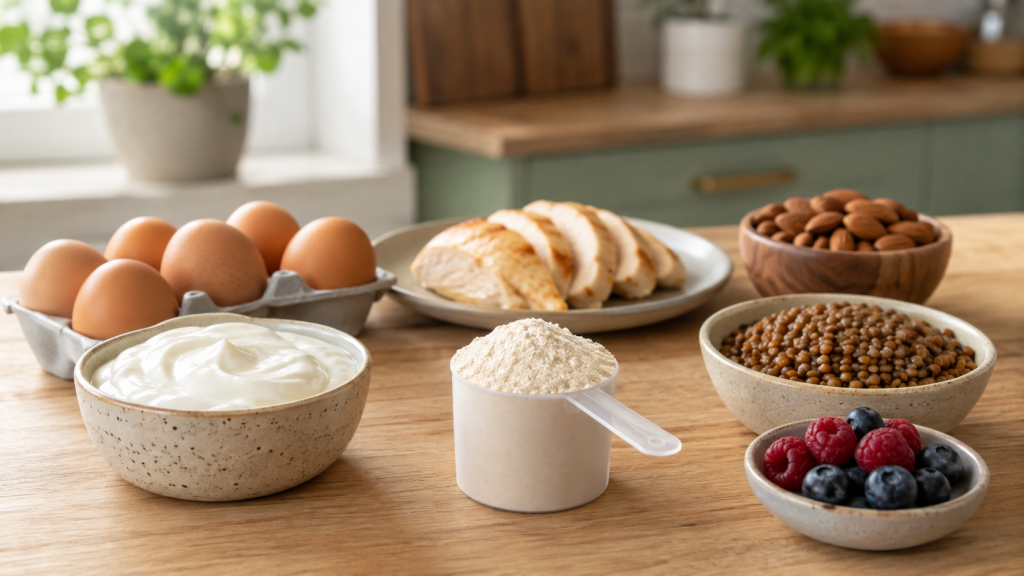
Protein from normal meals counts just as much as protein from a shake. Approximate examples include:
- Three large eggs: about 18–19 g
- 3.5 oz (100 g) cooked chicken breast: about 30–31 g
- One cup of Greek yogurt: often 17–23 g
- One 5 oz can of tuna: about 25–30 g
- One cup of cooked lentils: about 18 g
Exact amounts vary by brand, serving size and preparation. Track your normal intake for a few days using food labels or a reputable nutrition database.
Step 3: Use a shake only for the remaining gap
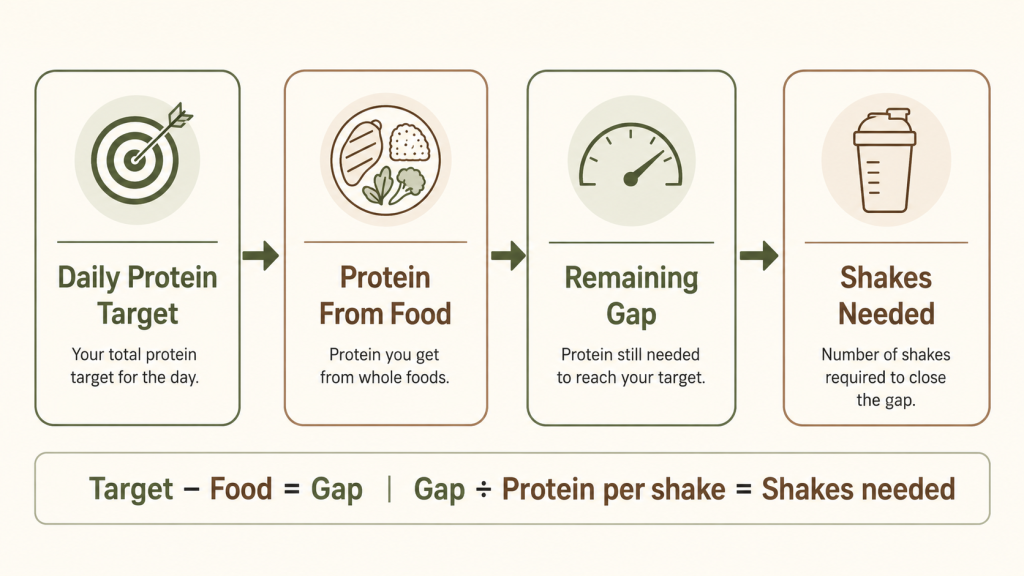
Subtract your food intake from your target.
If your target is 130 g and your meals provide 100 g, the remaining gap is 30 g. One shake containing 25–30 g may be enough.
Most protein powders provide approximately 20–30 g per serving. Milk, soy milk, Greek yogurt and nut butter can increase both the protein and calories.
Can You Drink 2 Protein Shakes a Day?
For many healthy adults, two protein shakes a day can be reasonable when they help meet a calculated protein target without replacing a varied diet.
Two shakes might make sense when you
- Train regularly and struggle to meet your target through meals
- Have a demanding schedule that makes protein-rich meals difficult
- Follow a plant-based diet and need a convenient protein option
- Are reducing calories while trying to preserve lean mass
- Have a small appetite but increased protein needs
Two typical shakes may provide around 40–60 g of protein. Their calories can range from roughly 200 in two simple water-based shakes to 800 or more in shakes containing whole milk, oats, fruit and nut butter.

When two shakes can become a problem
- They replace balanced meals. Protein powder does not automatically provide the fiber, fruits, vegetables and range of nutrients found in a varied diet.
- They add more calories than you realize. A nutritious homemade shake can still be calorie-dense.
- They cause digestive symptoms. Whey concentrate may trigger bloating, gas or diarrhea in people who do not tolerate lactose well.
- They push protein far beyond your needs. More protein does not always produce more muscle.
A small one-year crossover study in resistance-trained men found no harmful changes in measured blood lipids or markers of liver and kidney function at approximately 2.5–3.3 g/kg per day. However, this limited study should not be treated as a recommended intake or generalized to everyone.
Can You Drink 3 Protein Shakes a Day?
Three shakes may fit the routine of some bodybuilders, high-volume athletes, people training twice daily, or adults with high requirements and a small appetite. But for the average gym-goer, three is usually more than necessary.
Three shakes can provide 60–90 g of protein before any meals are counted. If your daily target is 120–140 g and your normal food already supplies 80–100 g, three shakes would probably take you far beyond what you need.
General sports-nutrition guidance suggests approximately 20–40 g of high-quality protein per meal for many athletes. Consuming more is not automatically dangerous or “wasted,” but it may not deliver additional muscle-building benefits in that particular meal. Total daily intake and sensible distribution across the day remain important.
The practical verdict is simple: three shakes are not automatically too many, but you should be able to explain why they are needed based on your total intake.
How Much Protein Is Too Much?
No universal upper limit for daily protein intake has been established for every adult. Very high intakes have been studied in small groups of resistance-trained people, but those studies do not prove indefinite safety for the general population.
Problems are more likely to appear through the overall diet than through a specific shake number:
- Digestive discomfort: Bloating, gas, cramps or diarrhea may result from lactose, sugar alcohols, large servings or certain additives.
- Nutrient displacement: Replacing meals with shakes can reduce fiber, fruits, vegetables and dietary variety.
- Unplanned calories: Homemade shakes can quietly turn into large meals.
- Added sugar: Some bottled shakes contain substantial added sugar. Check the Nutrition Facts label.
- Unnecessary expense: Protein beyond your useful target may add cost without improving results.
Maintain normal hydration, especially when exercising, but protein shakes do not automatically cause dehydration in healthy adults.
What about kidney health?
A 2018 meta-analysis involving 1,358 healthy adults found that changes in measured kidney function did not significantly differ between higher- and lower-protein diets. That does not prove that extreme protein intake is risk-free forever, and findings in healthy adults do not apply automatically to people with kidney disease.
Anyone with chronic kidney disease, reduced kidney function, liver disease or another relevant medical condition should obtain an individualized protein target from a physician or registered dietitian.
Pregnant people, teenagers and anyone receiving medical nutrition therapy should also seek personalized advice rather than relying on a general online range.
Is It Bad to Drink Protein Shakes Every Day?
Daily use can fit a healthy diet when the product is appropriate, the serving supports your actual needs, and most of your nutrition still comes from varied foods.
The main consideration is not simply the protein it is also the quality of the product.
Understand how supplements are regulated
The FDA does not approve dietary supplements for safety and effectiveness before they are marketed. Manufacturers are responsible for ensuring that their products are safe and their labels are truthful, while the FDA generally takes action when adulterated or misbranded products are identified after entering the market.
Independent testing has also raised concerns about contaminants in some protein products. A 2025 Consumer Reports investigation of 23 protein powders and ready-to-drink shakes found that more than two-thirds exceeded Consumer Reports’ daily threshold of concern for lead in a single serving. This was Consumer Reports’ benchmark, not an official universal FDA limit, and results varied substantially among products.
Practical precautions include:
- Choose products carrying credible independent certifications such as NSF Certified for Sport, Informed Sport or USP Verified, when available.
- Purchase from reputable manufacturers and sellers.
- Check serving size, calories, added sugar and allergens.
- Avoid products that make drug-like or unrealistic health claims.
- Remember that certification programs differ in what they test.
When Should You Drink a Protein Shake?
Total daily protein intake generally matters more than drinking a shake at an exact minute.
The popular idea that everyone must consume protein within 30 minutes after training is overly rigid. A study comparing 25 g of whey immediately before versus immediately after resistance training found no meaningful difference in the measured muscle or strength outcomes between the groups after ten weeks.
Useful times include:
- After training: Convenient, especially if your next meal is not soon.
- Before training: Helpful when you have not eaten for several hours, although a large shake may feel uncomfortable immediately before exercise.
- Between meals: Useful when you need additional protein without preparing another meal.
- At breakfast: Helpful if breakfast is normally low in protein.
- Before bed: A slow-digesting protein such as casein may be convenient for some athletes, but it is optional.
Aim to distribute protein across several meals or feedings instead of consuming most of it at once.
The exact time matters less than your daily total, but our guide explains when you should drink a protein shake based on your meals, workouts and goals.
Worked Examples
These examples are estimates, not individualized prescriptions:
| Person | Approximate target | Protein from food | Remaining gap | Possible shakes |
|---|---|---|---|---|
| 60 kg lightly active adult | 60 g | 65 g | 0 g | None needed |
| 70 kg adult lifting 4x/week | 120 g | 90 g | 30 g | 1 |
| 85 kg adult building muscle | 150 g | 105 g | 45 g | 1–2 |
| 95 kg high-volume athlete | 190 g | 125 g | 65 g | 2–3 |
| 75 kg vegan runner | 120 g | 75 g | 45 g | 1–2 |
The exact answer depends on the protein content of each shake.
Signs You May Be Drinking Too Many Protein Shakes
- Persistent bloating, gas, cramps or loose stools
- Reduced appetite for balanced meals
- A noticeable decline in fruit, vegetable or fiber intake
- Unplanned weight gain
- Protein intake substantially above your calculated target
- Relying on shakes because your normal eating routine needs improvement
If symptoms continue after reducing the serving or changing products, speak with a healthcare professional.
How to Use Two or Three Shakes Without Digestive Problems
- Try whey isolate instead of whey concentrate if lactose is the issue.
- Consider soy, pea or another suitable protein if you avoid dairy.
- Space shakes and meals across the day.
- Begin with a smaller serving when trying a new product.
- Check labels for sugar alcohols or ingredients that previously caused symptoms.
- Use water or lower-calorie milk when you do not need additional calories.
- Keep most meals based on varied foods such as seafood, poultry, eggs, dairy, soy, beans, lentils, whole grains, fruits and vegetables.
The Bottom Line
For many healthy adults, one or two protein shakes a day is enough. Three may be appropriate for certain athletes or people with unusually high protein needs, but it should be justified by the gap between their target and what they already eat.
Calculate your daily protein target, estimate how much comes from food, and use shakes only for the remainder. If you have kidney disease, liver disease, are pregnant, are under 18, take medication that affects nutrition, or have been given a therapeutic diet, ask a qualified healthcare professional for an individualized target.
If you are new to protein shakes, read our complete beginner’s guide and our step-by-step guide to making a protein shake.
Medical disclaimer: This article provides general educational information and is not a substitute for individualized medical or nutrition advice.
Sources
- Jäger R, et al. International Society of Sports Nutrition position stand: protein and exercise. Journal of the International Society of Sports Nutrition. 2017.
- Antonio J, et al. A high protein diet has no harmful effects: a one-year crossover study in resistance-trained males. 2016.
- Devries MC, et al. Changes in kidney function do not differ between healthy adults consuming higher- compared with lower- or normal-protein diets: a systematic review and meta-analysis. 2018.
- FDA. Questions and Answers on Dietary Supplements.
- Consumer Reports. Investigation finds high levels of lead in some protein powders and shakes. 2025.